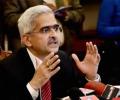
Reserve Bank Governor Shaktikanta Das has pitched for policy support from all sides -- fiscal, monetary and sectoral -- to nurture recovery of the economy hit by the second wave of the coronavirus pandemic. The dent on economic activity due to the second wave of the pandemic during April-May necessitated continuation of monetary measures to support the process of economic recovery to make it durable, Das had said while participating in the meeting of the Monetary Policy Committee (MPC) earlier in the month. "Overall, the second wave of COVID-19 has altered the near-term outlook, and policy support from all sides - fiscal, monetary and sectoral - is required to nurture recovery and expedite return to normalcy," Das said, as per the minutes of the meeting released on Friday.

Investors' wealth soared by Rs 10.58 lakh crore in three days of the market rally, where the BSE benchmark jumped over 2 per cent, and hit an all-time high on Monday. Extending its winning momentum to the third day running, the 30-share BSE Sensex jumped 363.20 points or 0.49 per cent to settle at 74,014.55. During the day, it zoomed 603.27 points or 0.81 per cent to hit its record high of 74,254.62.

However, India is likely to regain the tag of the fastest growth emerging economies of the world in 2018.

India's economic growth had slumped to decade low of 5 per cent in 2012-13.

Consumer goods firms and auto companies are witnessing an upturn in rural demand, which had been lagging for most of FY24. Expectations of a bumper rabi crop harvest have helped turn the tide. The Reserve Bank of India's (RBI's) Monetary Policy Committee kept the repo rate unchanged last week, noting that as rural demand catches up, consumption is expected to support economic growth in 2024-25.
The Reserve Bank of India on Wednesday retained the economic growth projection for the current financial year at 10.5 per cent, while cautioning that the recent surge in COVID-19 infections has created uncertainty over the economic growth recovery. In its last policy review, the RBI had projected a GDP growth rate of 10.5 pc for FY'22. Taking various factors into consideration, it said, "the projection of real GDP growth for 2021-22 is retained at 10.5 per cent consisting of 26.2 per cent in Q1, 8.3 per cent in Q2, 5.4 per cent in Q3 and 6.2 per cent in Q4."

The April-June quarter GDP slipped to 7 per cent from 7.5 per cent.

"Now is the time for countries with room in their budgets to deploy -- or get ready to deploy -- fiscal firepower. In fact, low interest rates may give some policymakers additional money to spend," new IMF chief Kristalina Georgieva said.

'We emphasise the importance of not basing investment decisions solely on electoral outcomes.' 'Instead, focusing on investing in high-quality businesses capable of prospering regardless of the political landscape is paramount.'

The Reserve Bank on Thursday marginally revised upwards the economic growth projection for the current fiscal to 6.5 per cent, from its earlier estimate of 6.4 per cent. Unveiling the first bi-monthly monetary policy of 2023-24 fiscal, RBI Governor Shaktikanta Das said the GDP growth in the first quarter of 2023-24 is expected at 7.8 per cent.

Officers across departments and ministries have been asked to speak to people across sectors for 'SWOT' analysis of issues for revival of the economy.

With economic activity still to reach pre-pandemic levels, the RBI may slow down the pace of rate hikes until next year to quell soaring inflation while supporting growth, the Asian Development Bank (ADB) says in its latest report. The Manila-based multilateral funding agency has raised the inflation forecast for the current fiscal year ending in March 2023 to 6.7 per cent from its earlier projection of 5.8 per cent. For the next fiscal year too, the forecast has been revised upwards to 5.8 per cent from 5 per cent earlier.

The country has been facing an ever-rising fiscal deficit, increasing debt and a hamstrung economy.

The revision will do little to help the Congress party-led ruling alliance, which faces an uphill battle in elections due by May amid allegations of economic mismanagement, corruption scams and high inflation.
.jpg)
The global brokerage firm in March had trimmed the growth forecast to 6 per cent and in June again it revised the growth estimate to 5.8 per cent.

India's exports may have touched an all-time high of $422 billion in 2021-22 but recession in key western markets and geo-political crisis due to the Russia-Ukraine war are expected to impact the growth of the country's outbound shipments in 2023. All the global trade promoting factors like political stability, movement of goods, adequate availability of containers and shipping lines, demand, stable currency and smooth banking systems are in disarray. Adding to the woes, COVID cases have again started rising in countries like China, Japan, South Korea and the US.

The report said in the recent months policy makers as well as the private sector have made some efforts to improve productivity.
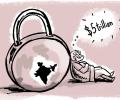
India decisively withstood global headwinds in 2023 and is likely to remain as the world's fastest-growing major economy on the back of growing demand, moderate inflation, stable interest rate regime and robust foreign exchange reserves. Despite widespread pessimism witnessed among the developed nations and the worsening geopolitical situation, India recorded a gross domestic product (GDP) expansion of 6.1 per cent in the March quarter. The growth moved up to 7.8 per cent in the June quarter and was 7.6 per cent in the September quarter. For the first six months of this fiscal, the growth was 7.7 per cent.

'From data on enquiries, we can build what we call a data lake or a data warehouse where data is classified into various cohorts and then we use AI and ML tools to predict demand down the line.'

Fitch Ratings on Friday said it has revised the outlook on India's sovereign rating to 'stable' from 'negative' as downside risks to medium-term growth have diminished on rapid economic recovery. Fitch Ratings kept the rating unchanged at 'BBB-'.

Disappointing quarterly earnings numbers and revenue forecast from IT services company Wipro also weighed on investor sentiments. The 30-share BSE Sensex fell 247.78 points or 0.38 per cent to settle at 65,629.24 points. During the day, it plunged 533.52 points or 0.80 per cent to 65,343.50 points.

Of the seven surveys presented under Modi govt, predictions of three were quite close to the actual GDP growth rate, one saw the base year change in between, but the last three were way off the mark.

Windies were restricted in their second innings by economical seamer Josh Hazlewood (3-23) and spinner Nathan Lyon (3-42).

Global trends and trading activity of foreign investors would largely dictate terms in the equity markets this week amid a lack of major domestic triggers, analysts said. Markets may face near-term consolidation due to elevated valuations, they noted. "While the previous week was predominantly shaped by developments in the US Federal Reserve policy, attention will now shift to the Bank of Japan's policy decision on December 19," Santosh Meena, Head of Research, Swastika Investmart Ltd, said.

Some of Modi's biggest reforms have met with fierce political opposition.

Moody's Investors Service on Thursday slashed India's economic growth projection to 8.8 per cent for 2022 from 9.1 per cent earlier, citing high inflation. In its update to Global Macro Outlook 2022-23, Moody's said high-frequency data suggests that the growth momentum from December quarter 2021 carried through into the first four months this year. However, the rise in crude oil, food and fertilizer prices will weigh on household finances and spending in the months ahead.

The agency had earlier said that the economy would grow at the rate of 5.8 per cent. In a teleconference, S&P said the revision was occasioned because of the positive policy responses by the country and improving global conditions, despite the deficient rains and lurking swine flu.

'I have serious doubts about the longevity of the NDA government and the longevity of the 18th Lok Sabha itself.'

These countries are feeling the heat from the US shale oil producers.

In its global economic forecast update for 2009, the World Bank projected a growth rate of 4 per cent for India during 2009-10, while the ADB, in its outlook, expects the economy to expand by 5 per cent. A separate outlook by the Organisation for Economic Cooperation and Development, a club of developed countries, has forecast a 4.3 per cent growth rate for India. India had last grown below this level in 2002-03, when the economy expanded by 3.8 per cent.

Pakistan Prime Minister Imran Khan on Monday approved the national cricket team's tour of England from the end of this month. The clearance from Imran, also a former Pakistan captain, came when Pakistan Cricket Board chairman Ehsan Mani met him in Islamabad and updated him on the cricket matters.

India's unstable politics and slow pace of reforms add to the downside risks said the bank's note.
The IMF, in its semi-annual global economic forecast, released in Washington on Wednesday, says that China is expected to grow by more than 11 per cent in 2007, while India is expected to expand by nine per cent. It, however, says growth may moderate somewhat across emerging Asia in 2008, reflecting slower trade growth as well as some policy tightening in countries facing overheating pressures.

India's economic growth could fall to 5.5 per cent this fiscal before seeing gradual recovery next year, a RBI-sponsored survey said.

Indian economy is expected to clock an average growth rate of 6.7 per cent till 2026-27 fiscal driven by domestic consumption, S&P Global Ratings senior Economist (Asia Pacific) Vishrut Rana said on Wednesday. He said the economic growth in the current fiscal is expected to come in around 6 per cent, lower than 7.2 per cent clocked in 2022-23. "We are seeing some headwinds from the trade side which is affecting activity and that is one of the factors that is affecting growth this year," Rana said at a webinar.

The brokerage believes the economic growth cycle is not fully priced in. It has revised upwards the earnings per share (EPS) estimate for Sensex.

After raising interest rate by a cumulative 250 basis points in 11 months, the Reserve Bank of India (RBI) on Thursday unexpectedly kept benchmark rate unchanged as global banking woes added uncertainty to the economic outlook. Five out of six members of MPC voted to remain focused on the withdrawal of accommodation to ensure inflation aligns with target while focusing on growth, RBI Governor Shaktikanta Das said on Thursday. The Monetary Policy Committee of the central bank decided to take a pause after a rate hike seen in previous six consecutive policies.

Apart from the human body, human food will bear direct repercussions. From staples such as wheat, to coffee, dairy, and even the great Hilsa face the threat of reduced supply due to the extreme heat.

Though electoral verdicts have historically been accepted, even though grudgingly, by all parties, there has been a sharper edge to the questions being raised by Opposition parties this time over the polling process, including the Election Commission.
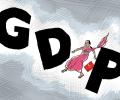
India's GDP is estimated to grow at 7.4 per cent in the financial year 2022-23 with rising prices triggered by the Russia-Ukraine conflict posing as the biggest challenge to the global economic recovery, Ficci's Economic Outlook Survey released on Sunday said. According to the survey, the Reserve Bank of India (RBI) is likely to start a rate hike cycle in the second half of 2022, while a repo rate hike of 50-75 bps is expected by the end of the current fiscal. The RBI is expected to continue supporting the ongoing economic recovery by keeping the repo rate unchanged in its April policy review, the survey said.
